The Future of Digital Payments: What Investors Need to Know
Let’s talk about the most profound revolution you use every day without even thinking: how we pay for things. The crumple of cash, the swipe of a card—these are becoming the vinyl records of finance. We’re living through a seismic shift from physical currency to digital value, and it’s creating one of the most explosive investment landscapes of our time.
For investors, this isn’t just about a new app to download. It’s about understanding the complete rewiring of the global financial nervous system. From the code on your phone to the blockchain protocols humming in the background, the future of digital payments is being written right now. If you want to see where the money is literally moving, you need to look here. Let’s decode the signals from the noise.
The Big Picture: More Than Just “Tap to Pay”
The shift to digital payments is often framed as a simple convenience story. But that’s like calling the internet a faster way to send mail. It’s a fundamental infrastructure change. We’re moving from payments as a discrete transaction to payments as an embedded, seamless experience.
Think about it: You hail a ride, it ends, you’re charged—no exchange. You walk out of a grocery store, your cart is tallied, your account is debited. The transaction disappears into the experience. This invisible, frictionless flow of value is the endgame, and it’s being built on several converging technological pillars.
For investors, this means looking beyond the point-of-sale. You need to examine the rails, the tokens, and the intelligence that make this invisible world possible.
The Central Pillars: Where the Action Is
The digital payments ecosystem is a layered cake. Each layer presents distinct opportunities and risks.
Layer 1: The Super-App & Embedded Finance Revolution
This is the most visible layer to consumers.
- The Rise of Super-Apps: In Asia, apps like WeChat and Alipay have shown the way. They’re not just for payments; they’re for messaging, shopping, investing, booking travel, and ordering food—all with a unified wallet. The West is catching up fast. PayPal, Block (Square), and even companies like Shopify are evolving from simple payment processors into broader financial ecosystems.
- Embedded Finance (or “Banking-as-a-Service” – BaaS): This is the real disruptor. Non-financial companies are embedding financial services directly into their platforms. When you buy now, pay later (BNPL) at checkout through Affirm or Klarna, that’s embedded finance. When Uber offers you a debit card for drivers, that’s embedded finance. The financial service is no longer a destination; it’s a feature.
- Investment Takeaway: Watch companies that are successfully building or enabling these closed-loop ecosystems. The winners will own the customer relationship and the rich data that comes with it.
Layer 2: The Infrastructure & “Pipes”
If super-apps are the sleek stores, this is the plumbing, wiring, and power grid. It’s less glamorous but absolutely critical.
- Real-Time Payment Rails: Systems like the FedNow Service in the U.S. (launched 2023) are a big deal. They enable instant, 24/7 bank-to-bank transfers, making ACH and even card networks look slow. Companies that facilitate these instant settlements (like Fiserv, FIS, or newer fintechs) are crucial enablers.
- Cross-Border Payment Innovators: Moving money across borders is still archaic and expensive. Fintechs like Wise and Remitly are using digital rails to slash costs and increase speed, disrupting the Western Union model. This is a massive, trillion-dollar market ripe for modernization.
- Investment Takeaway: These are often B2B (business-to-business) plays. They can offer more stable, recurring revenue models based on transaction volume, regardless of which consumer app is trending.
Layer 3: The Decentralized Frontier: Blockchain, CBDCs, and Crypto
This is the most speculative but potentially transformative layer.
- Central Bank Digital Currencies (CBDCs): Over 100 countries are exploring these. A CBDC is digital cash, issued and backed by a central bank (like a digital dollar). It could streamline government benefits, enable programmable money for specific uses, and challenge the role of commercial banks. This is a regulatory and technological play that will create winners and losers across the entire banking sector.
- Stablecoins and Blockchain Infrastructure: Stablecoins (crypto tokens pegged to assets like the US dollar) are becoming the preferred settlement layer for much of the crypto economy. The efficiency and transparency of blockchain-based settlement could eventually challenge traditional rails for certain transactions. Watch the companies building secure, compliant infrastructure here.
- Investment Takeaway: High risk, high potential reward. This area is heavily influenced by regulation. Look for projects with strong compliance focus, real-world utility beyond speculation, and robust technological foundations. It’s an area for strategic allocation, not a core portfolio holding for most.
Key Megatrends Shaping the Investment Thesis
Beyond the layers, specific powerful currents are directing the flow of capital.
1. The Death of Plastic (As We Know It)
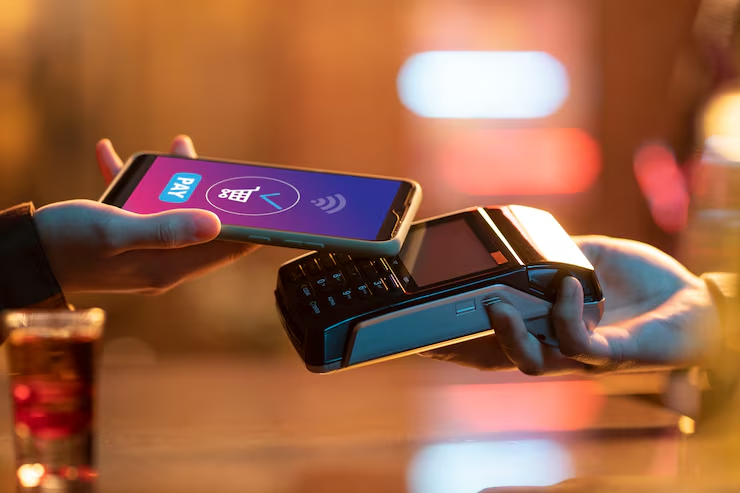
The physical card is becoming a piece of backup plastic in your wallet. The future is digital wallets (Apple Pay, Google Pay), tokenized cards stored on your phone, and virtual card numbers for online use. This shifts power toward the device makers and wallet providers who control the tap.
2. Biometric Authentication: Your Body is Your PIN
Passwords and even PINs are the weak link. The future is facial recognition, fingerprint scans, and even behavioral biometrics (how you hold your phone, your typing rhythm) to authenticate payments seamlessly and securely. This boosts security and further reduces friction.
3. AI-Powered Fraud Detection and Hyper-Personalization
AI is the brain of the new payments network. It analyzes patterns in real-time to block fraud more effectively than any human rulebook. Simultaneously, it uses spending data to offer personalized financial products (a micro-loan at the perfect moment, a savings tip) at scale. Companies with best-in-class AI will have a major edge.
4. Financial Inclusion as a Driver
Billions globally remain underbanked. Digital payments, via a simple smartphone, are the gateway to the formal financial system. Companies that successfully serve this massive emerging market—in Latin America, Africa, Southeast Asia—will see extraordinary growth. Mercado Pago (Latin America) and M-Pesa (Africa) are prime examples.
Risks & Considerations for the Astute Investor
This future isn’t without its potholes.
- Regulatory Thunderstorms: Payments touch national security, monetary policy, and consumer protection. Regulation will be heavy and shape the winners (see the ongoing scrutiny of BNPL and crypto).
- Cybersecurity Arms Race: As money becomes digital code, it becomes a target. The cost of a major breach is existential.
- Winner-Take-Most Dynamics: Network effects are powerful. Consumers won’t use ten different payment apps. Consolidation is inevitable.
- Technological Obsolescence: Today’s hot fintech could be tomorrow’s Myspace if it fails to adapt.
Conclusion: Investing in the Flow
The future of digital payments is about invisible, intelligent, and instantaneous movement of value. For investors, the opportunity isn’t in betting on a single “PayPal killer.” It’s in understanding the layered architecture of this new system.
The most prudent strategy is likely a basket approach: exposure to the established ecosystem builders (the PayPals, Visas, and Blocks adapting to the new world), the critical infrastructure providers (the Fiservs and Adyens), and a carefully considered, risk-adjusted allocation to the transformative, high-growth potential of embedded finance and selected, utility-focused crypto/blockchain infrastructure.
Don’t just watch your money grow. Understand how money itself is changing. The flow of value is the heartbeat of the global economy, and that heartbeat is going digital.
FAQs
1. Is it too late to invest in digital payments? Haven’t I missed the big run-up?
We are still in the early middle innings of a global, multi-decade transition. While pioneers like PayPal and Square had huge runs, the shift from ~50% of transactions being digital to near-100%, and the embedding of finance into every platform, represents a tidal wave of opportunity still building. New leaders will emerge in niches like B2B payments, cross-border, and embedded finance.
2. Are cryptocurrencies like Bitcoin a digital payment investment or a speculative asset?
For now, the vast majority of Bitcoin trading is speculative asset investment, not use as a daily payment medium. Its volatility and transaction speed make it poor for buying coffee. However, Bitcoin’s potential role as a digital store of value (“digital gold”) and the underlying blockchain technology are the investment theses. For pure “payments,” look to stablecoins and the infrastructure that supports them.
3. What’s a simple way for a regular investor to get exposure to this trend?
Consider a targeted ETF. Funds like the ARK Fintech Innovation ETF (ARKF) or the Global X FinTech ETF (FINX) hold a basket of companies involved in digital payments, fintech, and blockchain. This provides instant diversification across the theme without having to pick individual winners. Always research the ETF’s holdings and fees first.
4. How will Central Bank Digital Currencies (CBDCs) affect my current bank?
It’s a potential disintermediation threat. If people can hold digital cash directly with the Fed, why keep as much in a commercial bank account? Banks might see a reduction in low-cost deposit funding. However, central banks will likely design CBDCs to work through commercial banks. This is a key area to watch, as the design choices will massively impact traditional banking stock valuations.
5. What’s the single most important metric to watch in a digital payments company?
Total Payment Volume (TPV) or Gross Payment Volume (GPV). This is the total dollar amount of transactions processed by the platform. It’s the top-line measure of the company’s scale, network effect, and “utility.” Revenue and profit are typically a small percentage of TPV, but consistent TPV growth indicates a thriving, essential platform. Check the trend: is TPV growing, and at what rate?